Hedge Cutting & Maintenance
in Chinnor
Professional hedge cutting and ongoing maintenance by NPTC qualified arborists. We carry out hedge work for residential, commercial and public sector clients, from small garden box hedges to large rural boundary hedging.
Why use a tree surgery company for your hedges?
Most hedge cutting can be handled by a gardener with a trimmer, and for a small, low hedge that is often perfectly adequate. But for anything larger, taller, more overgrown or more technically demanding, there are real advantages to using a qualified team.
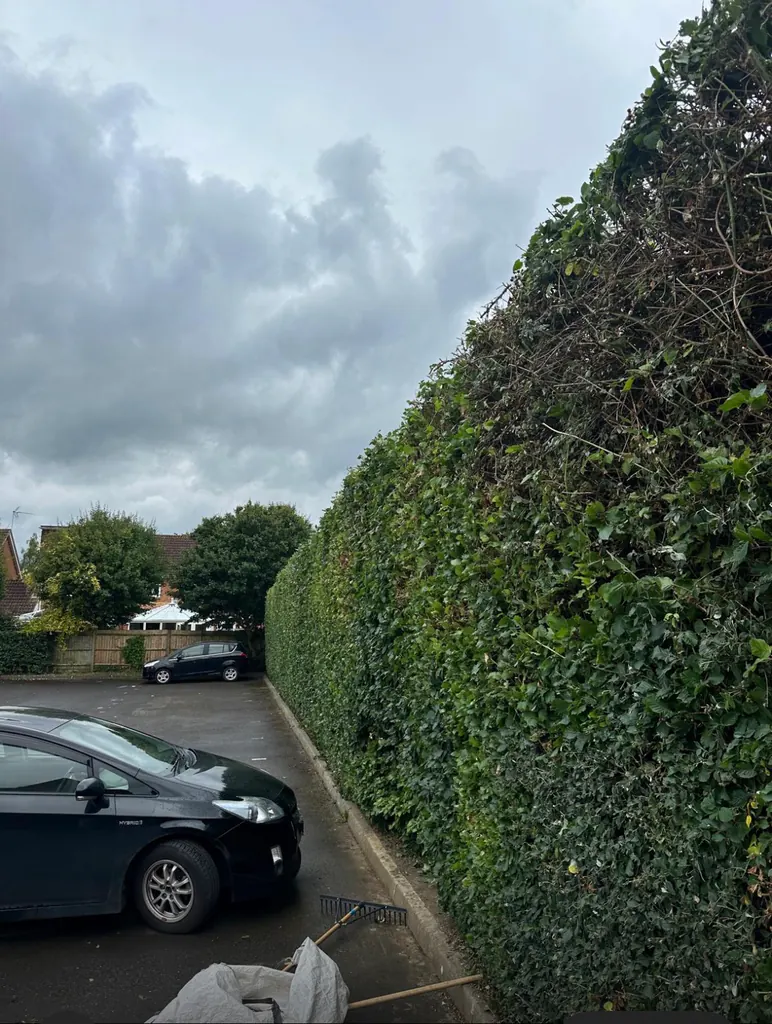
We carry £10 million public liability insurance, which matters when working at height alongside boundaries, driveways, vehicles and footpaths. Our team is NPTC qualified and City & Guilds accredited, and we use our own cherry picker to tackle tall hedges safely that would be dangerous with a ladder and a domestic trimmer.
We also understand the biology of hedges. Cutting at the right time, to the right specification and with proper technique is what separates a hedge that thrives and densifies from one that is repeatedly stressed or gradually opens up and loses its privacy.

Hedge services we provide
Cutting & trimming
Routine cutting to maintain your hedge at the desired height, width and shape, to a clean, even finish with all arisings removed. One-off cuts or a regular annual or twice-yearly schedule.
Hedge reduction
Where a hedge has grown well beyond the desired size, we reduce it back to manageable dimensions. All cuts are made to a suitable lateral to encourage healthy, dense regrowth and avoid open wounds.
Shaping & formal trimming
For architectural and formal features, box, yew, hornbeam and beech, precise shaping to clean geometric lines. We work to the shape agreed with you and take the time to get it right.
Rejuvenation
Neglected, open or gappy hedges can often be brought back through hard rejuvenation pruning. Hawthorn, blackthorn, field maple, privet and hornbeam respond well. We assess species and condition first.
Hedge removal
Where a hedge is diseased, dead, inappropriate or unwanted, we carry out full removal including disposal. Stump grinding is available separately if the roots need eliminating.
Planting advice
Replacing or establishing a hedge? We advise on appropriate species for your location, soil and purpose, whether privacy screening, wildlife value or formal boundary definition.
Nesting birds and the Wildlife and Countryside Act 1981
This is one of the most important things to understand about hedge work. Under the Act, it is a criminal offence to intentionally damage or destroy the nest of any wild bird while it is in use or being built. Cutting a hedge during the nesting season and destroying an active nest, even inadvertently, is an offence.
The main nesting season runs from March to August inclusive. During this period we will not cut hedges where active nests may be present without first carrying out a careful nest check. The safest windows for routine cutting are late August to late February, with November to February ideal for most species. We take this seriously and factor it into all scheduling.
Hedge species we work with
Leylandii & conifers: The most frequently requested hedge work we do. Fast-growing and tall if left unmanaged. They must never be cut back into dead brown wood, as they will not regenerate from old wood. Regular trimming while green is the only reliable approach.
Beech & hornbeam: Both retain dried leaves through winter when trimmed in late summer, giving year-round screening. They tolerate quite hard reductions and are best cut once a year in late summer.
Box: The classic formal hedging plant, but prone to box blight and box moth caterpillar, both of which can devastate a hedge quickly. We can advise on monitoring and, if needed, replacement species.
Yew: One of the longest-lived and handsomest formal hedges. Slow-growing but tolerant of hard cutting, even back into older wood, making yew an excellent candidate for rejuvenation after years of neglect.
Hawthorn, blackthorn & native mixed: Traditional rural hedging with high wildlife value. These respond exceptionally well to hard cutting and can be laid as well as trimmed. Timing is critical for wildlife reasons.
Privet & laurel: Privet is fast-growing and tolerates hard cutting, often needing two or three cuts a year. Laurel is best cut with secateurs or loppers rather than a trimmer, which leaves an untidy browning finish, and ideally before mid-August.

Why Customers in Chinnor Choose NP Tree Management
A family business, rooted in the region
NP Tree Management is a family business based in Hook, Hampshire, with a reputation built over decades of work across the region. It is run by lead arborist Neil, working alongside his son Rhys, who is coming up through his own arboriculture qualifications.
Around them is a team of experienced, fully qualified arborists, bringing over 50 years of collective expertise to every job.
NPTC qualified & City & Guilds accredited, whole team
BS 3998 compliant on all tree work
Own cherry picker for safe, efficient access
£10 million public liability insurance
24-hour emergency callout, no call-out charge
500+ Checkatrade reviews, 9.97/10 rated
Free site visits & quotations, no obligation
Trusted by schools, councils & medical centres

Frequently asked questions
How often should a hedge be cut?
Can you cut hedges during the bird nesting season?
Can a very overgrown hedge be saved?
How tall a hedge can you cut?
Do you remove the cuttings?
How much does hedge cutting cost?

Get a free hedge cutting quote
Whether you need a one-off tidy-up or ongoing seasonal maintenance for a hedge of any size, contact NP Tree Management for a free site visit and honest, straightforward advice.
